



Agrégateur de flux
List of China’s Cases on Recognition of Foreign Judgments [2025 Update]
As the new year begins, it’s a good time for a fresh start. One timely occasion to do so is the release, on 31 December 2025, of the annual update of the List of China’s Cases on Recognition of Foreign Judgments (Case List), prepared since 2019 by China Justice Observer (CJO), founded by Guodong Du and Meng Yu (updates for the years 2020, 2022, 2023, and 2024 were also previously posted on this blog).
The Case List is compiled on the basis of a collection of “all Chinese court decisions involving the recognition and enforcement of foreign judgments (REFJ), as well as foreign decisions concerning the recognition and enforcement of Chinese judgments.” The stated intention behind this endeavor is to “build reasonable expectations on REFJ in China.”
The Case List constitutes a particularly valuable source of information on judicial practice relating to the recognition and enforcement of foreign judgments in China, both under international treaties concluded by China (for a full list, see here) and under domestic law, namely the Civil Procedure Law of the People’s Republic of China (2023 Amendment), Articles 298–303.
According to the 2025 update, a total of 120 cases involving China and 26 foreign States and regions, excluding foreign divorce judgments, have now been collected. This represents an increase of 11 cases compared to the previous update (109 cases in the 2024 update).
Key features of the 2025 update include the following:
-
The List comprises 26 concise reports for each jurisdiction, together with a chart of bilateral judicial assistance treaties which China has concluded with 39 States, of which 35 bilateral treaties include judgment enforcement clauses.
-
A total of eleven newly added cases involve one treaty jurisdiction – Uzbekistan (one case), and five non-treaty jurisdictions, namely, Australia (one case), New Zealand (four cases), Singapore (two cases), South Korea (two cases), and the United States (one case).
-
Please note that Tian v Xu [2023] NZHC 3259 marks the first reported instance of a New Zealand court recognizing and enforcing a Chinese civil settlement statement (also known as a mediation judgment). By treating such instruments as equivalent to consent judgments, the New Zealand High Court has adopted a pro-enforcement approach consistent with precedents in Canada (Wei v Li 2019 BCCA 114) and Australia (Bank of China Limited v Chen [2022] NSWSC 749), providing a clear contrast to the earlier restrictive view expressed in Singapore (Shi Wen Yue v Shi Minjiu & Anor [2016] SGHC 137).
-
Another noteworthy case is Sunvalley Solar Inc. v Baoding Tianwei Solarfilms Co. Ltd. (2019) Ji 01 Xie Wai Ren No. 3, where a Chinese court refused to enforce a U.S. default judgment rendered in breach of a valid arbitration agreement. By holding that a defendant’s absence does not constitute an implied waiver, the Chinese court shielded arbitration clauses from being bypassed via foreign default judgments.
-
Other newly added cases, be it foreign judgments to be enforced in China or Chinese judgments to be enforced in foreign jurisdictions, provide a valuable comparative perspective on key issues in the eyes of courts from different jurisdictions, such as reciprocity ( e.g., the de jure reciprocity applied by a Beijing court in enforcing a South Korean IP judgment, the reciprocal consensus confirmed by a Shanghai court in enforcing a Singapore monetary judgment), natural justice (New Zealand), ascertainment and interpretation of foreign law (Singapore, Australia).
-
Each case has been reviewed, and more details, such as the grounds, the case numbers, and causes of action, have been added.
-
Case analyses have been aggregated under the country tags since 2022, so it is now easier to track down relevant cases, together with their information and analyses, in each country/region report. For example, under the tag ‘US-China Judgments Recognition and Enforcement’, one can find relevant case analyses involving mutual recognition and enforcement of judgments between the US and China.
For further details see here and here.
Happy New Year to all!
Catégories: Droit international général, Flux des sites DIP
Book review: Research Handbook on International Child Abduction: The 1980 Hague Convention (Edward Elgar Publishing, 2023) – Part I
Written by Mayela Celis, Maastricht University
International child abduction is a topic that has given rise to an ever-increasing number of publications (our latest blog post attests to this trend). It easily sparks emotions among experts, sometimes triggering divergent views. However, from a global perspective, there is consensus on the basic principle: States should combat international child abductions and a child should be returned to the State of habitual residence, unless an exception is made out. In 2023, Elgar published the book entitled “Research Handbook on International Child Abduction: the 1980 Hague Convention”, eds. Marilyn Freeman and Nicola Taylor (Edward Elgar Publishing Limited, 2023). Although published a couple of years ago, it remains poignantly relevant.
This book brings together an adult who was abducted as a child, practitioners, judges, academics, NGO officials and central authority personnel. Many of the authors are at the forefront of this field and their contributions have left a long-lasting legacy in this area of law. While some topics are considered from an academic perspective, others have a more practical focus, striking the right balance between academia and practice.
This book review will be divided into two parts. The present and first post will deal with Part II to Part VI of the book. The second post will consider Parts VII & VIII and will include some personal views. The table of contents is available here.
This book is divided into 8 Parts:
- PART I – Introduction and key themes
- PART II – The impacts of international child abduction
- PART III – The 1980 Hague Convention – History and longitudinal trends
- PART IV – The 1980 Hague Convention – Implementation and operationalisation
- PART V- International child abduction in selected geographical regions
- PART VI – Non-Hague Convention countries
- PART VII – Key perspectives on international child abduction and Hague Convention proceedings
- PART VIII – Reflection and future directions
At the outset, it should be noted that this book has been dedicated to the memory of Anne-Marie Hutchinson for her invaluable contribution to this field.
Part II – The impacts of international child abduction
This Part begins with the long-term reflections of a former milk carton kid (Chapter 2 – FINKELSTEIN WATERS). A personal story of a woman who remembered seeing herself on a milk carton, when she was abducted as a child by her father and on the run, as part of a nationwide advertisement to find missing children. She recounts her life after her abduction from Norway to the United States, the previous abduction of her brothers from the United States to Israel and then to Norway, and the actions she has taken against child abduction, which includes speaking widely to the media and working with Lady Catherine Meyer, a left behind parent and founder of PACT.
It then moves on to discuss the psychological issues in child abduction and high conflict cases (Chapter 3 – CALVERT). The Chapter is rightly entitled in part “Ghosts in our Genes”, given that children in high conflict cases are haunted by these ghosts (or traumas) way into adulthood. It addresses the impact of developmental issues, parenthood and the voice of the child, noting that children want to be involved and valued, acknowledged and respected.
Part III – The 1980 Hague Convention – History and Longitudinal Trends
Part III begins by providing a historical context of the Hague 1980 Child Abduction Convention (subsequently, Child Abduction Convention or Convention), including some notable US developments preceding the treaty and a description of the Hague drafting process (Chapter 4 – ELROD). It also incorporates useful insights into the post-ratification history of the Convention and of the role of the HCCH as a leader in creating international family law.
This Part then continues with the value and challenges of statistical studies on the Child Abduction Convention (Chapter 5 – LOWE, STEPHANS). This article is written by the persons commissioned to draft these statistical studies so it is all the more valuable. After explaining the origin of the global studies, among other topics, it describes the modern statistical studies’ findings, such as the number of Hague applications and the outcomes. Beyond the descriptive nature of this article, it also provides useful insider information about funding issues, methodology, difficulties experienced, and challenges ahead. As stated in this article, this contribution was unable to take on board the latest study conducted on the basis of data of the year 2021, which provides valuable information regarding child abduction and the coronavirus pandemic, and which was prepared by the authors of this contribution (for more information, see Prel. Doc. No 3 of January 2023 of the 2023 Special Commission).
A note to the reader: although it was an idea left open by the authors, it should be noted that in 2021 the HCCH Council on General Affairs and Policy (CGAP Conclusion & Decision No 19) mandated the discontinuance of INCASTAT, an electronic statistical database.
PART IV – The 1980 Hague Convention – Implementation and operationalisation
Part IV begins with the role of the Permanent Bureau in the operation of the Child Abduction Convention (Chapter 6 – GOH ESCOLAR). This article starts with the role of the Permanent Bureau, the secretariat of the HCCH, and lists some of its tasks, which include: preparing, organising sessions and meetings, supporting the proper operation of the Child Abduction Convention, providing post-convention assistance (such as country profiles, holding seminars and INCADAT), facilitating communications and maintaining networks (including the International Hague Network of Judges and the Malta Process), organising and participating in international meetings, and maintaining of HCCH Regional Offices (in Latin America – ROLAC – and the Caribbean and Asia Pacific – ROAP -) and their key role.
A note to the reader: As of July 2025, there is a new HCCH Regional Office in Rabat, Morocco. For more information, click here.
It then moves on to the extremely relevant chapter on helping battered mothers and their children using Article 13(1)(b) (Chapter 7 – EDLESON, SHETTY, FATA) – . The authors begin by contextualizing the problem and setting forth decades of social research on domestic violence and their effects on battered women and children. This article then continues by analysing court decisions where the grave risk exception has been applied. It also discusses the Hague Domestic Violence project. Finally, it provides concrete recommendations to the Permanent Bureau of the Hague Conference and suggests possible actions for Central Authorities and practitioners. In particular, some recommendations to the Permanent Bureau include: encouraging the recognition that the exceptions to the return of children are an integral part of the Convention, focusing on the protection of children rather than adopting a technical approach to this treaty, and facilitating the drafting of a new revised edition of the Guide to Good Practice on Article 13(1)(b) with more comprehensive information on domestic violence. It should be noted that one of the authors has spearheaded research in this area with the ground-breaking book Battered Women, Their Children, and International Law: The Unintended Consequences of the Hague Child Abduction Convention (Northeastern University Press, 2012).
Subsequently, this Part deals with child participation and the child objection exception (Chapter 8, SCHUZ). This Chapter is divided into child participation and the child objection exception. With regard to the child participation, the direct and indirect hearings and separate representation are considered, with the author underscoring the need to convey the views of the child and not only the perceptions of the child’s interest, as well as the benefits of separate representation. Concerning the child objection exception, this chapter analyses the exception in a very structural manner by dividing in age and maturity, child’s objection including strength and validity and finally, the tricky question of discretion, which the author divides into welfare and convention considerations. Importantly, the author calls for internalising children’s rights when considering this exception and the adoption of a more child-centric approach.
Finally, this Part discusses a 20-year evolution in judicial activism (Chapter 9 – THORPE). The author was the first to table the proposal in 1998, on behalf of the UK, to create the International Hague Network of Judges. This chapter recounts the developments of direct judicial communications and of this network from their origin to up to 2021. With the support of key articles published in the HCCH Judges Newsletter, as he argues certain loss of memory – even to reminiscence his life during the Second World War -, the author takes us on the long journey of these initiatives, providing inside information and interesting details of the conferences held in the southern part of the Netherlands in the late nineties, in Brussels in 2009, and ending with some perspectives and conclusions during the corona pandemic. Importantly, he notes that “this is a history of harmony since, apart from the earliest days, there has been no real dissent and there is not a single case in which miscarriage of justice has resulted from an abuse of the general principles governing direct judicial communications.”
Part V – International child abduction in selected geographical regions
This Part focuses on the developments in two European regional courts and specific regions or States.
This Part begins with an analysis of the case law of the European Court of Human Rights (ECtHR) (Chapter 10 – KRUGER / LEMBRECHTS). This contribution is divided into the court’s role in international child abduction and the exceptions to return. The former deals primarily with Article 8 of the ECHR (and to a lesser extent art. 6) in areas such as the voice of the child and the duty to act expeditiously, while the latter provides a summary on the ECtHR case law on the exceptions under the Child Abduction Convention (arts. 12(2), 13(1)(a) and (b), 13(2) and 20). At the outset, this article includes a useful list of cases initiated by left-behind parents and by abducting parents (footnotes 7 and 8), from which conclusions may be drawn as to existing trends (see in particular that the cases heard before the Grand Chamber were initiated by abducting mothers). Importantly, references are made throughout this contribution to X v. Latvia and its impact on the best interests of the child and the exceptions under the Child Abduction Convention. It also includes relevant recent cases and a couple of interesting cases belonging to – what I refer to as – the “twilight zone”, that is the uncertain period between the Grand Chamber judgments of Neulinger and X v Latvia. Among their conclusions, they note that while the case law of the ECtHR is only binding on the members of the Council of Europe, its guidance can be useful to other States.
This Part then goes on to analyse the role of the Court of Justice of the European Union and international child abduction (Chapter 11 – HONORATI). It focuses on the relevant provisions of Brussels II ter, putting an emphasis on key concepts such as habitual residence and studying the court’s case law on this concept which amounted to 9 decisions as of July 2022 (see footnote 19 – citing benchmark cases such as A and Mercredi v. Chaffe, among others). Importantly, a section is devoted to the retention of jurisdiction, in which emphasis is laid on the differences between Brussels II ter and the 1996 Hague Convention. It then moves on to study return proceedings, including the child’s safe return and the overriding mechanism. Finally, the author submits that the guidance provided by the CJEU may be of interest to courts located in third States and may be of some value when dealing with similar topics.
Subsequently, Part V delves into the study of specific geographic regions or States: Australasia and the Pacific, United States, Asia, Africa and the Caribbean region.
With respect to Australasia and the Pacific (Chapter 12 – HENAGHAN / POLAND / KONG), it makes a recount of the developments of child abduction in Contracting and non-Contracting Parties to the Child Abduction Convention. First, it analyses key concepts such as rights of custody and habitual residence, as well as the most litigated issues under the Child Abduction Convention (in particular, the exceptions) in Australia, New Zealand and Fiji. It underlines the differences and similarities among these jurisdictions. Subsequently, it describes the (national or convention-inspired) procedures adopted by Pacific countries that are not Contracting Parties to the Convention when dealing with international child abduction, including Tonga’s steadfast intention not to join this treaty and Samoa’s review of family law.
With regard to the United States (Chapter 13 – CULLEN, POWERS), it describes the robust interpretation of the Convention in this State, noting that the US Supreme Court has rendered judgments in five key cases so far. The article focuses on two of those cases (Monasky and Golan), and touches briefly upon Abbott. Interestingly, this article pinpoints recent federal court judgments that may have an important impact on the operation of the Convention. It also raises the need to deal with the mature child exception in the United States. This Chapter should be read in conjunction with Chapter 7 (Fleeing for safety…).
With respect to Asia, Chapter 14 – NISHITANI focuses primarily on developments in Japan, with some brief references to other Asian countries (such as India and Pakistan). It starts by outlining the reason why it has been a challenge for Asian States to join the Convention. It then analyses the way key Convention concepts have been interpreted in Japan, including two Japanese Supreme Court judgments (2017 and 2020) regarding the change in circumstances when executing return orders and objections of the child. References to other useful Japanese INCADAT cases are included throughout this article. The author also discusses the reform to the Implementation Act and the Civil Executive Act of Japan in 2019 and helpfully suggests improving it by introducing ex officio enforcement mechanism (as opposed to relying on a party’s initiative). Finally, this article refers to the Malta Process, after sharing an interesting reflection on Islamic countries, the author makes a call for States to join the 1996 and 2007 Hague Conventions and Protocol, arguing that these treaties will support a safe return of the child.
With regard to Africa, Chapter 15 (SLOTH-NIELSEN) discusses primarily developments in South Africa, a country with vast jurisprudence on this topic. It begins with an analysis of the benchmark case Sonderup and Tondelli and the interplay of the Convention with the best interests of the child, as well as other South African cases. It also briefly mentions two outgoing cases from Morocco, decided in France and the United States, and legislation from Mauritius. Acknowledging that jurisprudence in this region is scant (apart from South Africa), the author suggests further judicial training in the region.
Regarding the Caribbean region, Chapter 16 (GORDON HARRISON) provides a summary of the status quo in this region regarding international child abduction. It includes a useful table with a list of 32 countries/territories in the Caribbean region and their status (independent State or a territory/country of a State – i.e. UK, France, the Netherlands, USA -). Information is included regarding specific States parties to the Convention (incl. any acceptances of accessions, which may be challenging to determine in the case of territories. Each State must extend the Convention to that particular dependent territory and this extension must have entered into force), and any designations to the Hague Network Judges. This chapter highlights that even in non-Contracting States, the spirit of the Convention has been persuasive (see p. 240, regarding Jamaica before acceding to the Convention) and that judges have been designated for the Hague Network in non-contracting countries (Suriname, Aruba and Sint Maarten). It ends with a useful list of challenges, recommendations and conclusions, which include judicial training and the development of internal guidelines.
A note to the reader: Just for the sake of clarification, it should be noted that St. Kitts and Nevis accepted the accession of Peru and not otherwise, and that Trinidad and Tobago has accepted 5 instead of 6 accessions.
Part VI – Non Hague Convention Countries
This Part deals with non-Hague Convention countries and more specifically, with India. Throughout the book reference is made to the fact that India is not a party to the Child Abduction Convention and what that means for children and families, given the mobility of the Indian population.
In this regard, the reader should bear in mind that this Part should be read in conjunction with Chapter 12 (Australasia and the Pacific), which includes research on Island nations not yet a party to the treaty, such as Samoa and Tonga, Chapter 14 (Asia), which refers to the hesitancy of India to join and information regarding Islamic States, and Chapter 16 (the Caribbean region), which refers to non-Contracting Parties, such as Suriname, and the lack of acceptances of accessions – the Convention applies bilaterally for acceding States and thus in the case of a lack of an acceptance to an accession, the Convention does not apply -.
With regard to non-Hague Convention countries, Chapter 17 (MORLEY) provides, from a practitioner’s perspective, an overview of the existing practices in some non-Contracting States (including in those the author has litigated, such as a case between Japan and Bangladesh). He begins his contribution by noting the existence of bilateral agreements and MOUs on family law matters, the latter of which have proven to be deficient or highly ineffective. The author also emphasises the Malta process and lists highly useful strategies to recover children from non-Hague countries. This Chapter also deals with India (see pp. 244, 252-253, 256).
With respect to India, Chapter 18 (MALHOTRA, MALHOTRA) briefly analyses the Indian legislation under which a return may be requested and concludes that a writ of Habeas Corpus is the only means available. It then moves on to consider the Indian case law, in particular the numerous – and very contrasting throughout the years – judgments of the Indian Supreme Court, which is undoubtedly the more interesting part of the article. It starts with the historical position adopted by the Indian Supreme Court and the dramatic shift in position in 2017, with the abandonment of principles such as “first strike” (first seized) and the primacy of comity of Courts, as well as the concept of forum conveniens in these matters. It also analyses Supreme Court decisions rendered in 2019, as well as features the widely publicised case of Jasmeet Kaur v. Navtej Singh. Importantly, it briefly explains the Indian failed attempt to gear up to become a party to the Child Abduction Convention and the sterile bill resulting from those efforts. It concludes by praising the emergence of mirror order jurisprudence in child custody matters, which has been adopted in an Indian-USA case.
Part II of this post will be published later on in 2026… stay tuned and Happy New Year!
Catégories: Droit international général, Flux des sites DIP
The EAPIL Blog in 2025
How was the year 2025 for the EAPIL blog? Rather busy, to put it shortly! Some 300 new posts were published over the last twelve months, covering a broad range of subjects. A little less than a third of them were concerned with rulings (including upcoming rulings, as in the case of Marta Requejo’s monthly […]
Catégories: Droit international général, Flux des sites DIP
XLK v XLJ: Comity Beyond the Child Abduction Convention
By Haoxiang Ruan, PhD candidate at Hitotsubashi University (Tokyo, Japan). Haoxiang Ruan consistently maintains an interest in international family law, which led him to undertake the 2024-2025 academic stay at Kyoto University (Kyoto, Japan).
From the perspective of state participation, the Convention of 25 October 1980 on the Civil Aspects of International Child Abduction (the “Child Abduction Convention”) stands as one of the most successful instruments of the Hague Conference on Private International Law (HCCH), boasting 103 Contracting Parties to date. This widespread adherence is largely driven by the pervasive—and increasingly difficult-to-ignore—problem of international child abduction, which affects even non-Contracting States. China, a populous country deeply engaged in globalization, exemplifies this reality. A recent custody ruling in Singapore concerned a child who had been brought to the country by his father in breach of an order issued by a Chinese court—an incident underscoring how cross-border family disputes transcend the formal boundaries of the Convention.
I. The Brief of XLK v. XLJXLK (the Father) and XLJ (the Mother) are both Chinese nationals, with their habitual residence in China. In 2023, a Chinese court rendered a divorce judgment, which provided that the child “shall be raised and educated” by the Mother. After the Father’s appeal was dismissed, he removed the child from China to Singapore and enrolled him in school there. As a consequence of these acts, the Father was subjected to detention for non-compliance with the prior judgments, prohibited from leaving China, and had his travel documents declared invalid. These measures, however, did not alter the fact that the child remained in Singapore and was not in the Mother’s care, which led the Mother to turn to Singapore in seeking the child’s return.
In 2025, a District Judge of the Singapore Family Court, following consolidation of proceedings, heard the Mother’s application seeking an order for sole custody and care and control of the Child together with the Father’s application for joint custody and liberal access, and rendered a decision ([2025] SGFC 42). In light of the finding that “the facts show clearly that this is a case of outright child abduction” ([2025] SGHCF 50, para. 6), the District Judge identified two core concepts running throughout the case, namely the interests of the child and the comity of nations.
On the one hand, the District Judge emphasized that “[i]s it in interest of the child for him to be returned to the Applicant Mother” constituted “the crux of the matter.” Accordingly, “[h]e explained in some detail his analysis of the welfare of the child with reference to” Singapore case law, ultimately concluding that “it was in the best interests of the Child for the Mother to be given care and control, and to enable the Mother to exercise this right, she should also be given sole custody for the purpose of having the Child returned to her in China” ([2025] SGHC(A) 22, para. 10). On the other hand, the District Judge took the view that, once the Child was returned to China, no Singapore court order would be necessary, as China constituted the proper forum for addressing the Father’s application for access, particularly given that the Chinese courts had already rendered a judgment, and that “it would be ‘against the comity of nations’ for another jurisdiction to make further orders on the same matter” ([2025] SGHC(A) 22, para. 10). The District Judge therefore allowed the Mother’s application and dismissed the Father’s application.
The Father’s subsequent appeal was dismissed by the Family Division of the High Court ([2025] SGHCF 50). The Family Division stated that it agreed entirely with the District Judge’s reasoning on these two concepts, emphasizing that, whether on the basis of the interests of the child or comity, either consideration alone was sufficient to justify dismissing the appeal, as reflected in its statement that “[t]he doctrine of comity of nations has immense force on the facts of this case, and on that basis alone, the appeal ought to be dismissed … I am of the view that the crucial point is that it is in the best interests of the child to be with the mother” ([2025] SGHCF 50, para. 7).
This reasoning prompted the Father to raise objections and to file an application for permission to appeal. Specifically, the Father contended that the emphasis placed on comity, together with the use of the language of “child abduction,” indicated that the judge had conflated the circumstances in which the Convention applies with the present case, which did not fall within its scope because China is not a Contracting Party ([2025] SGHC(A) 22, para. 18). On this basis, he alleged a prima facie error of law, namely that “the Judge failed to apply [the welfare-of-the-child principle] by reasoning that ‘comity overrides welfare'” ([2025] SGHC(A) 22, para. 22). Accordingly, the Father requested that the appellate court address “important questions of law regarding (a) the extent to which considerations of comity may override the welfare principle; and (b) the weight to be accorded to custody decisions of foreign courts” ([2025] SGHC(A) 22, para. 38).
On November 5, the Appellate Division of the High Court rendered its decision ([2025] SGHC(A) 22), dismissing the Father’s application. The Appellate Division’s central rationale was that “the Father’s submission fails to recognise that the Judge did not dismiss the appeal on the sole basis of comity” ([2025] SGHC(A) 22, para. 23), such that no prima facie error of law arose. In other words, the Appellate Division took the view that, in the present case, taking comity into consideration did not entail overriding the interests of the child, as both the District Judge and the Family Division had treated the interests of the child as “the crux” or “the crucial point.” On that basis, the District Judge had correctly applied Singapore law, by testing in detail, with reference to relevant case law, the factors advanced by the Father, an approach which the Family Division expressly endorsed (see [2025] SGHC(A) 22, paras. 21–30).
At the same time, however, the Appellate Division held that the Family Division’s statement that “on [the doctrine of comity of nations] alone, the appeal ought to be dismissed” was incorrect. In other words, in the Appellate Division’s view, although both courts’ application of the law, centering on the interests of the child, was entirely correct and sufficient to justify dismissing the Father’s appeal, consideration of comity was unnecessary. Accordingly, “[a]ny error … on the relevance of comity therefore has no impact on the ultimate outcome of the case” ([2025] SGHC(A) 22, para. 37). Proceeding from this position, the Appellate Division concluded that the “important questions of law” advanced by the Father, which in fact presupposed the applicability of comity in the present case, could not be regarded as being of “general importance which would justify granting permission to appeal in the present application” ([2025] SGHC(A) 22, para. 40).
II. The Comity in XLK v. XLJThe divergence in judicial positions in XLK v. XLJ raises a question: was consideration of comity in this case, as the Appellate Division opined, unnecessary, or, more broadly, should comity be disregarded altogether in cases falling outside the scope of the Child Abduction Convention?
Admittedly, in convention cases, consideration of comity is principled in nature, with comity in this context having been elevated to an obligation under international law. Even though the Convention is “[f]irmly convinced that the interests of children are of paramount importance in matters relating to their custody,” its practical operation nonetheless rests on comity, which, when the Convention is applied by domestic courts, may occasionally generate tension between comity and the interests of the child. This, however, does not mean that such tension arises from an inherent contradiction between the two concepts. On the contrary, no necessary conflict exists between them. The actual and original foundation of comity lies in serving the interests of sovereign states (Ernest G. Lorenzen, Story’s Commentaries on the Conflict of Laws—One Hundred Years After, 48 Harv. L. Rev. 15, 35 (1934)), and, for that very reason, it should not be deployed to challenge the best interests of the child as a human right (Art. 3 of the Convention on the Rights of the Child).
More specifically, according to the Preamble of the Convention, comity may be regarded as being justified by, and oriented toward, the better realization of the interests of the child; pursuant to Articles 13 and 20 of the Convention, comity is suspended in defined exceptional circumstances to secure the interests of the child. Viewed as a whole, comity constitutes an obligation introduced by this interests-of-the-child–oriented international convention by virtue of its nature as an instrument binding states, such that inter-state comity in this context unambiguously serves the realization of the individual interests of the child. This understanding is in fact facilitated by the breadth of the concept of the best interests of the child, as illustrated by Lord McDermott’s explanation in the English case J v. C, in which consideration of the child’s interests was described as “a process whereby, when all relevant facts and relationships, claims and wishes of parents, risks and choices and other circumstances are taken into account and weighed” ([1970] AC 710 (HL)).
However, this results in the realization of the interests of the child under the Convention being less direct than its realization under domestic law, as reflected in the authority cited by the Appellate Division in XLK v. XLJ, which observed that “the understanding of the child’s welfare under the Convention is not the substantive understanding (as under the domestic law of guardianship and custody) but rather the more limited understanding, that where she has been unlawfully removed from her habitual residence, her welfare is best served by swiftly returning her to her habitual residence” ([2025] SGHC(A) 22, para. 32).
Against this background, it is not difficult to understand why, although XLK v. XLJ was a non-convention case, the Appellate Division nonetheless acknowledged that “it might be useful to contrast the present application with applications for the return of a child under the [Convention]” ([2025] SGHC(A) 22, para. 32). Within this Convention-referential reasoning, the child’s swift and immediate return appears to be a typical outcome of considering comity under the Convention, yet its essence remains a decision reached after assessing the interests of the child. In other words, while the fact that the Chinese courts had issued subsisting orders on custody was “connected to the notion of comity of nations,” it was, in substance, merely one of the “non-comity-related factors relevant in the assessment of the Child’s welfare” ([2025] SGHC(A) 22, para. 36).
Accordingly, the question posed above may be framed more concretely as whether, beyond the Convention, comity should be considered directly and explicitly, or whether courts should instead adopt a Convention-referential logic while avoiding the application of the Convention itself, thereby subsuming comity within the interests of the child and avoiding its direct consideration. In XLK v. XLJ, the positions taken by the District Judge and the Family Division clearly reflected the former approach, albeit in a more aggressive form, whereas the Appellate Division adopted the latter. Admittedly, the District Judge and the Family Division should not have treated comity and the interests of the child as parallel and equivalent lines of reasoning, given that, even within the scope of the Convention, the interests of the child remains the paramount consideration, and a fortiori, beyond the Convention, comity is not even framed as an obligation. In this sense, the Appellate Division’s criticism of the two courts was justified. It nevertheless appears to have moved to the opposite extreme by effectively excluding any consideration of comity. Although the Appellate Division did not expressly state that comity should not be considered, it treated the interests of the child as the sole operative concept in the present case, through its interpretive logic that “comity-connected factors are included in welfare.”
III. Considering Comity beyond the ConventionBefore diving into this question, a preliminary point should first be clarified, that the interests of the child is not an exclusive or monopolistic consideration. Under the Convention, comity operates as an independent consideration serving the interests of the child, which is described as being “of paramount importance,” and functions at jurisdiction allocation, which explains why, in certain circumstances, it may come into tension with the interests of the child. Outside the scope of the Convention, however, whether expressed as “a primary consideration” in the Convention on the Rights of the Child or as a “paramount consideration” in the Guardianship of Infants Act 1934 of Singapore as applied in the present case, such formulations merely emphasize the preeminent weight of the interests of the child in a comparative sense, rather than conferring upon it an exclusive character. Accordingly, the question is not whether comity can be considered, but whether comity should be considered.
In essence, the Convention elevates comity to a binding obligation, manifested in the relinquishment of jurisdiction; beyond the Convention, by contrast, comity only “persuades; but it does not command” (Mast, Foos & Co. v. Stover Mfg. Co., 177 U.S. 485 (1900)). Accordingly, the state where the abducted child is located is entirely free, if it so chooses, to disregard comity. From a technical perspective, the nature of a child custody order itself also furnishes the state with a basis for not considering comity, in that such an order is typically not final and may be modified in light of changed circumstances or the interests of the child (Robert A. Leflar, American Conflicts Law 490–493 (1977)).
This, however, does not mean that, beyond the Convention, there is no reason at all to take comity into consideration. In other words, outside the scope of the Convention, and while fully respecting the preeminence of the interests of the child, there are both policy and technical reasons for taking account of the role of states.
From a policy perspective, considering comity can extend the Convention’s influence even indirectly, which was apparent in Singapore prior to its accession to the Convention, as AB v. AC ([2004] SGDC 6) being a paradigmatic example, in which scholars have observed that the court effectively recognised a foreign custody order on the basis that it had been made by the court of the child’s habitual residence, thereby reflecting the Convention’s spirit, a course of action described as legally questionable but policy-wise correct (See Joel Lee, Private International Law in the Singapore Courts, 9 Sing. Y.B. Int’l L. 243, 244 (2005)). It is therefore unsurprising that, now that Singapore has acceded to the Convention, courts may still take the Convention into consideration even in cases where it is inapplicable ([2025] SGHC(A) 22, para. 32). In the recent case, however, the Singapore courts abandoned this policy-driven, indirect application of the Convention, which, while wholly avoiding the risk of applying the Convention to non-Convention cases, to some extent, diminished the Convention’s appeal to non-Contracting States by leaving its foundational logic unarticulated.
Even for states that have not acceded to the Convention, comity remains a principle worthy of consideration. For the state of the child’s habitual residence, the relevant interests lie not only in the child’s being returned to its jurisdiction but also in the jurisdictional interest in adjudicating the substantive custody disputes, both of which amount to the state’s expectation of fulfilling its child-protection obligations. If the state where the abducted child is located wholly disregards comity, it thereby fails to show respect for the jurisdictional interest of the state of the child’s habitual residence. That consequence means that, where origin and destination are reversed, culturally divergent interpretations of the interests of the child may dominate judicial discretion, producing a situation in which the child’s return is less chance to be a uniform outcome of considering the interests of the child and where such an outcome cannot be influenced by comity to vindicate that interests. Moreover, the absence of comity can render potential bilateral or multilateral cooperation beyond the Convention awkward for lack of reciprocal foundations (see Blondin v. Dubois, 189 F.3d 240, 248 (2d Cir. 1999)), thereby inhibiting the emergence of regional alternatives to the Convention.
Globalization has strengthened comity’s reciprocal character, such that a state’s showing trust in foreign courts’ custody determinations is both necessary and not fundamentally at odds with the interests of the child. On the contrary, comity can assist non-Contracting States in obtaining reciprocal comity in custody disputes, thereby giving Contracting Parties greater opportunities to realize their child-protection objectives. The Convention highlights this value of comity in custody matters, yet by hard-wiring comity into a binding obligation, a feature some states find difficult to accept. Outside the scope of the Convention, however, comity is merely persuasive, and for states hesitating to join the Convention, this softer form of comity should be more palatable and may serve as a practicable intermediate step toward accession.
As for the technical benefits of comity, they have, in fact, long been reflected in non-Convention cases, which may be observed through the referential use of the Convention in such cases. According to a Singapore scholar’s synthesis, drawing on the practice of the English courts, courts generally adopt four approaches in dealing with non-Convention cases (Chan Wing Cheong, The Law in Singapore on Child Abduction, 2004 Sing. J. Legal Stud. 444 (2004)). Two of these take the Convention as a reference. One involves indirectly adopting the Convention’s understanding of the interests of the child by presuming that returning the abducted child accords with the child’s welfare, an approach reflected in XLK v. XLJ. The other involves directly adopting the Convention’s policy, under which return is refused only where the foreign court is in principle unacceptable or where one of the Convention’s specified exceptions applies. The close linkage of these two approaches to the Convention allows them to be regarded as applications of comity beyond the Convention. The remaining two approaches, although not involving a direct reference to the Convention, share the same foundation as the Convention, namely, comity. One is the application of forum non conveniens, and the other is the treatment of comity as a consideration equal to the best interests of the child. As noted above, the latter should not be accepted, while forum non conveniens is likewise closely associated with comity.
The most immediate technical benefit brought about by comity is certainty. This certainty manifests itself, on the one hand, at jurisdiction, thereby to some extent preventing parents from forum shopping through abduction. On the other hand, it manifests itself in the application of laws, as comity can, beyond the Convention, to some degree mitigate divergences in the interpretations of the interests of the child across different legal cultures, thereby contributing to a measure of predictability. Put differently, comity can provide a unifying, inter-state relational context for an issue that would otherwise be subject to divergent interpretations across fragmented legal systems.
In addition, another technical benefit of considering comity beyond the Convention lies in providing a jurisprudential foundation for the development of related legal mechanisms. Beyond the application of forum non conveniens noted above, a prominent example is the mirror order. Although, on its face, a mirror order may appear to run counter to comity (see Danaipour v. Mclarey, 286 F.3d 1, 22–25 (1st Cir. 2002)), it nonetheless fully reflects the highest regard for the interests of the child, and its “practice… may actually be seen as enhancing comity” (Rhona Schuz, The Doctrine of Comity in the Age of Globalization: Between International Child Abduction and Cross-Border Insolvency, 40 Brook. J. Int’l L. 31, 82–83 (2014)).
IV. Concluding RemarksIn XLK v. XLJ, the Appellate Division did not dispute that the application of comity in the present case would not have undermined the correctness of the outcome. Indeed, the two guiding considerations, comity and the interests of the child, did not lead to conflicting results. Rather, they served distinct yet complementary purposes: the former addressed state interests while the latter safeguarded private interests. Even assuming that tension were to arise between them in a non-Convention context, comity would not necessarily impede the interests of the child. A court may duly consider comity while still arriving at a decision fully aligned with the child’s interests—thereby simultaneously honoring international reciprocity and fulfilling its protective duty toward the child.
In sum, comity can serve a significant function in cases falling outside the scope of the Child Abduction Convention. From a policy perspective, it can, to some extent, encourage non-Contracting States to align more closely with the Convention or allow them to benefit from the Convention’s advantages without formal accession to the Convention. From a technical perspective, it can, to some degree, alleviate the inherent uncertainty in the interpretation of the interests of the child and provide a jurisprudential foundation for the development of related legal mechanisms. Accordingly, for states that have not yet formed a clear intention to accede to the Convention, comity remains a consideration worthy of serious attention, offering an intermediate approach that approximates the Convention while preserving a measure of sovereign caution.
Catégories: Droit international général, Flux des sites DIP
IPRax: Issue 1 of 2026
The first issue of the IPRax (Praxis des Internationalen Privat- und Verfahrensrechts) for 2026 will be published on 6 January. It features a thought-provoking article by Bea Verschraegen about a particularity of German PIL, the doctrine of the so-called “hidden renvoi” (versteckter Rückverweis). The other articles are also of great interest, as you can see […]
Catégories: Droit international général, Flux des sites DIP
[Out Now] Bruijnen on Recognition of Kafala and Child Marriage in Family Law and Migration Law
Leontine Bruijnen (Maastricht University) has recently published a book titled Recognition of kafala and child marriage in family law and migration law (Wolters Kluwer, 2025) based on her dissertation written under the supervision of Prof. Dr. Thalia Kruger and Prof. Dr. Marta Pertegás.
According to the publisher’s website, “This book explores how the recognition of kafala and child marriage varies between family law and migration law, and how greater alignment can be achieved.” “It analyzes the role of private international law, EU principles, and legal concepts such as the best interests of the child and legal certainty. Through case studies from Belgium and Germany, the study offers an in-depth perspective on the legal challenges and possibilities for better harmonizing these complex issues. It constitutes a valuable resource for legal scholars and policymakers.”
The book’s blurb reads as follows:
When a person moves to another State, the question arises how the receiving State should recognise the legal institutions concerning that person. This is particularly pertinent when the legal institution does not exist (or not in the same form) in the receiving State. Two examples of such institutions in Belgium and Germany are kafala and child marriage.
Whether and how these institutions are recognised is important for family law purposes, such as parenthood and inheritance, as well as for migration law purposes, such as family reunification and the qualification as an unaccompanied minor. Legal uncertainty may arise when a kafala or child marriage is recognised for family law purposes but not for migration law purposes, or vice versa.
Recognition of kafala and child marriage in family law and migration law: private international law bridging the gap? explores how private international law is used, and could be used, to determine the recognition of kafala and child marriage for family law and migration law purposes. It also examines the influence on recognition of EU principles, public policy, the best interests of the child, the right to private and family life, and the principle of legal certainty. The research includes an analysis of the Belgian and German case law on kafala and child marriage.
The book’s central aim is to assess whether, and how, private international law can serve as a bridge between the recognition of kafala and child marriage for family law purposes and migration law purposes, with the aim of achieving greater alignment between the two areas of law.
The book’s table of contents and an excerpt from the book are available on the publisher’s website.
Catégories: Droit international général, Flux des sites DIP
Out Now: Un Derecho Internacional Privado centrado en los derechos de las personas (Tirant lo Blanch 2025)
By Eduardo Álvarez-Armas, Assistant Professor of Law at the Universidad Pontificia Comillas (Spain) and Université Catholique de Louvain (Belgium)
Earlier this year, publishing house Tirant Lo Blanch released “Un Derecho Internacional Privado centrado en los derechos de las personas” (Private international law as focused on the rights of individuals), a volume that compiles the papers presented in the “VII Seminario AEPDIRI sobre temas de actualidad de Derecho Internacional Privado”, the 7th workshop on trending topics in private international law organized by the Spanish Association of International Law and International Relations Professors. These workshops on trending topics, initiated in 2015, have become one of the most significant academic activities of the Asociación Española de Profesores de Derecho Internacional y Relaciones Internacionales (AEPDIRI). They provide a yearly forum for collective reflection on the most dynamic and debated questions in each of the association’s academic branches (public international law, private international law and international relations), enhancing the exchange of research and practice ideas among academics, judges, and legal professionals, from Spain and beyond.
As reflected in this book (digitally available for free / open access here), the 2024 edition of the workshop was held on 14 March 2024 at the Law School of the Universidad Pontificia Comillas (ICADE) in Madrid, and was convened by Professors Beatriz Campuzano Díaz (Universidad de Sevilla), Guillermo Palao Moreno (Universidad de Valencia), and Salomé Adroher Biosca (Universidad Pontificia Comillas). The theme chosen for the workshop sought to re-frame and place the spotlight of the field on its ultimate subjects — human beings — by examining how private international law addresses delicate aspects of personal status, family relations, vulnerability, migration, and human rights in transnational contexts. This ambitious thematic framework led to a workshop of remarkable breadth and diversity, gathering scholars from numerous Spanish and foreign universities as well as practitioners who are actively engaged in cross-border litigation and consultancy. Both speakers and the audience engaged in lively discussions around various sub-topics that highlight private international law’s human-centred vocation; amongst the latter, the regulation of personal capacity in cross-border situations; international aspects of parenthood; the rights of vulnerable persons; the impact of digitalisation on personality rights; corporate due-diligence obligations and human-rights accountability in global value chains; civil liability of multinational enterprises for human-rights violations; new challenges in immigration law; migrants’ rights viewed through a private-law lens, etc.
After a presentation by the organizers, the book begins with the key-note speech, delivered by Nicolas Nord, Professor at the Université de Strasbourg and Secretary General of the International Commission on Civil Status, “Un Derecho Internacional privado centrado en los derechos de las personas: un análisis transversal, crítico y prospectivo”: a “cross-cutting, critical and forward-looking analysis” of the book´s theme (the field “as focused on the rights of individuals”) that rightly sets the tone and paves the way for the three conceptual blocks of presentations (round tables) that the conference was structured around.
The first round table, “Rights of vulnerable persons”, focused on the international protection of vulnerable individuals, both minors and dependent adults, and was led by two main presentations. The first one by Laura Martínez-Mora Charlebois, Secretary at the Hague Conference on Private International Law, was entitled “La protección internacional de las personas, en particular los niños, a través de los Convenios de La Haya” (The international protection of persons, particularly children, through the Hague Conventions), and outlined the role of the Hague instruments in safeguarding children’s rights. The second one, by Mónica Herranz Ballesteros (UNED) analysed “La protección de los derechos de los menores y de los adultos en el Derecho Internacional Privado de la Unión Europea” (The protection of the rights of minors and adults in the private international law of the European Union), examining how EU private-law measures complement human-rights protection. Five other papers enriched this session: María González Marimón, “La protección del adulto vulnerable en la UE: un principio en construcción” (The protection of vulnerable adults in the EU: a principle under construction); Briseida Sofía Jiménez-Gómez, “Los derechos de protección de datos en Internet y la decisión de adecuación con EE.UU.” (Data protection rights on the Internet and the “adequacy decision” vis-à-vis the US); Lidia Moreno Blesa, “La confluencia del Derecho Internacional público y privado en la protección de adultos vulnerables” (The convergence of public and private international law in the protection of vulnerable adults); Natividad Goñi Urriza, “Novedades de la propuesta de Reglamento sobre protección de adultos y competencia judicial internacional” (Novelties in the proposed Regulation on the protection of adults, and international jurisdiction); Raúl Lafuente Sánchez, “Foros competentes y normas de conflicto en la protección de adultos” (Jurisdiction and conflict rules on adult protection); and Stefania Pia Perrino, “Post-mortem reproduction, filiation and parenthood”. Jointly considered, these papers illustrated the increasing interaction between private international law and other fields of law (as for instance, data protection, or bioethics) highlighting how the field serves as a vehicle for the effective implementation of individual rights across borders.
The second round table, “Due diligence, corporations, environment and human rights” explored the interplay between corporate conduct, sustainability, and human-rights accountability from a private international law perspective and began with presentations by Francisco Javier Zamora Cabot (Universitat Jaume I) on “Empresas, derechos humanos y acceso: cruzando -de nuevo- el Atlántico” (Business, human rights and access: crossing the Atlantic once again), reflecting on comparative experiences of transatlantic litigation, and Antonia Durán Ayago (Universidad de Salamanca) on “Diligencia debida y Derecho Mercantil materialmente orientado hacia la sostenibilidad: implicaciones para el Derecho Internacional Privado europeo” (Due diligence and sustainability-oriented commercial law: implications for European private international law), assessing the EU’s take on regulatory aspects of due diligence and sustainability as combined with private international law. Further papers included: Laura García Álvarez, on the EU directive on corporate due diligence and its private-international-law implications (“Extraterritorialidad y competencia judicial internacional en la Directiva de la UE sobre diligencia debida de las empresas en materia de sostenibilidad”); Nerea Magallón Elósegui, on the Delegated Regulation (EU) 2023/2772 enhancing non-financial reporting standards (“Un nuevo paso en el camino de la diligencia debida hacia una mayor transparencia de la conducta empresarial: el Reglamento delegado por el que se completa la Directiva 2013/34/UE en lo que respecta a la norma de presentación de información no financiera”); and María Font-Mas, on the Anti-SLAPP Directive and its private international law aspects (“La Directiva (UE) 2024/1069 sobre demandas estratégicas contra la participación pública (Anti-SLAPP): aspectos de Derecho Internacional privado”). Overall, this session underscored the growing convergence between private-law regulation, environmental governance, and human-rights enforcement, stressing private international law’s potential as a tool for corporate accountability and sustainable global commerce.
The third and final round table, “Inmigration through a rights-based perspetive”, examined migration and foreign-national status through the prism of individual rights and vulnerability, and was led through presentations by Isabel Eugenia Lázaro González (ICADE) on “El derecho a la identidad de los extranjeros y la determinación de la edad” (The right to identity of foreigners and age determination), addressing legal and evidentiary issues in identifying minors, and by Carmen Azcárraga Monzonís (Universitat de València) on “Extranjería y violencia contra la mujer” (Immigration laws and violence against women), assessing the evolution and remaining challenges of Article 31 bis of Spain’s Organic Law 4/2000. Further presentations enriched the debate, including: Lucas Andrés Pérez Martín, “Gestión de niños y niñas migrantes no acompañados” (Management of unaccompanied migrant children); Nieves Irene Caballero Pérez, “Los niños invisibles y su reconocimiento jurídico internacional” (Invisible children and their international legal recognition); Dulce Margarida de Jesus Lopes, “Matrimonio de menores en el Derecho privado europeo e internacional” (Marriage of minors in European and international private law); Antonio Quirós Fons, “La nueva tarjeta azul y los derechos del inmigrante altamente cualificado” (The new blue card and the rights of highly skilled immigrants); Vito Bumbaca, “Protective coordination for children seeking asylum”; and Carmen Parra Rodríguez, “Acogida familiar de menores migrantes no acompañados” (Foster care for unaccompanied migrant children). This final round table enshirned the human-rights dimension of migration management, emphasising how private international law contributes to the recognition of personality, to family unity, and to the procedural protection of migrants and minors.
In a nutshell, the book serves as a collective reaffirmation of private international law as a filed of law at the service of persons and their rights, integrating theoretical innovation with practical commitment to justice in an interconnected world. It further condenses, black on white, the workshop’s exceptional thematic richness and participation, demonstrating the vitality of the AEPDIRI network and the relevance of private international law to contemporary human-rights debates.
Catégories: Droit international général, Flux des sites DIP
HCCH Monthly Update: December 2025
HCCH Monthly Update: December 2025
Membership
On 4 December 2025, Indonesia applied to become a Member of the HCCH. On the same day, the Secretary General of the HCCH opened the six-month voting period during which all current Members of the HCCH may cast their vote on the proposal. Following this voting period, and provided a majority of votes are cast in favour, Indonesia will be invited to become a Member by depositing an instrument of acceptance of the Statute of the HCCH. More information is available here.
Meetings & Events
On 1 December 2025, the third meeting of the Working Group established to finalise the Good Practices document relevant to the 1965 Service, 1970 Evidence, and 1980 Access to Justice Conventions was held online. More information is available here.
From 2 to 4 December 2025, the Experts’ Group on Carbon Markets met for the third time, continuing its study of the private international law issues arising from carbon markets. More information is available here.
On 10 December 2025, the third Post Adoption Services Workshop was held online, hosted by the Central Authority of Canada under the 1993 Adoption Convention. The event had over 120 participants from over 35 Contracting Parties to the Convention. More information is available here.
On 11 December 2025, the Permanent Bureau (PB) of the HCCH hosted a book launch for the publication of The Hague Convention on Choice of Court Agreements: A Commentary, in celebration of the tenth anniversary of the entry into force of the 2005 Choice of Court Convention. More information is available here.
Other Developments
The PB of the HCCH has launched a public consultation on the Draft Text of a possible new convention on parallel proceedings and related actions, to be held from 18 November 2025 to 26 January 2026. Experts, practitioners and judges from diverse legal traditions with experience in cross-border litigation and private international law more broadly are encouraged to participate in the consultation. More information is available here.
On 23 December, the PB of the HCCH announced the conclusion of the e-Country Profiles project, resulting in the development and modernisation of online Country Profiles for a number of key HCCH Conventions. Contracting Parties to these Conventions can now easily publish legal and practical information about their implementation of these instruments, making the e-Country Profiles a valuable tool for use by public authorities, legal practitioners and other interested parties. More information is available here.
These monthly updates are published by the Permanent Bureau of the Hague Conference on Private International Law (HCCH), providing an overview of the latest developments. More information and materials are available on the HCCH website.
Catégories: Droit international général, Flux des sites DIP
Enjoy the Festive Season!
As customary, few posts will be published during the Winter break on the EAPIL blog. We’ll be resuming our usual pace on 7 January 2026. The editors of the blog wish readers and subscribers, and more generally all those in the EAPIL community, all the best for the Festive Season and the new year! In […]
Catégories: Droit international général, Flux des sites DIP
Private International Law-Related Movies Worth Watching During the Holidays
The holiday season is approaching. Hopefully, that will mean that most of us can leave our keyboards to rest and not only catch up with family and friends, but also enjoy some good movies. And then why not movies on private international law themes? Below is a short list of recommendations on three movies based […]
Catégories: Droit international général, Flux des sites DIP
Municipio de Mariana v BHP. An add-on re municipalities’ capacity to sue under lex incorporationis as it were.
[If you do use the blog for research, practice submission or database purposes, citation would be appreciated, to the blog as a whole and /or to specific blog posts. Many have suggested I should turn the blog into a paid for, subscription service however I have resisted doing so. Proper reference to how the blog is useful to its readers, will help keeping this so.]
There is of course one additional issue on conflict of laws that is part of the Municipio judgment (Municipio de Mariana et al v BHP Group UK Limited and BHP Group Limited [2025] EWHC 3001 (TCC); I discussed the Rome II issue here), namely the question of standing for the municipalities in the English proceedings. I discuss it in an extra post here for to simply insert it in my earlier post would render that post’s title incomplete.
This is discussed [1090] ff and it is worth inserting the alternative arguments in full:
1090. BHP’s case is that the Municipalities’ claims should be dismissed as they do not have the constitutional capacity to bring proceedings abroad. Their bringing of these claims in the Courts of England and Wales constitutes acts that are exclusive to the Federal Government as representative of the Federative Republic of Brazil under Article 21(I) of the Constitution, namely: (a) a waiver of immunity from jurisdiction (such waiver being a prerogative of national sovereignty); and/or (b) establishing a legal relationship with a foreign State.
1091. It is said that the effect of the Municipalities bringing suit in England is to subject themselves to the jurisdiction of this Court, waiving jurisdictional immunity from which they benefit as a matter of Brazilian law. This is an act on the international plane, beyond the autonomy of the Municipality and one that only the Federal Government has the constitutional capacity to carry out. Therefore, Municipalities can only bring claims abroad through or with the Federal Republic of Brazil.
1092. The Claimants’ case is that the Municipalities are local government bodies with their own separate legal personality which have administrative responsibility over defined territories within Brazil. They are thus legal persons distinct from the individuals and businesses whose interests they represent and distinct also from the Federal Republic of Brazil. The Municipalities are recognised as public entities by Article 41(III) of the Civil Code, subject to internal public law, as well as the Constitution.
1093. Under Brazilian law, Municipalities are treated as having the same capacity as a natural person so far as holding and exercising rights is concerned. In those circumstances, it is said that in the absence of express prohibition or limitation, Municipalities are in the same position as any other natural or non-natural legal person. Like any other such person they can therefore sue and be sued, both within Brazil and in courts outside Brazil as any other natural or non-natural legal person.
O’ Farrell J starts with the common ground:
1094. It is common ground that the issue of standing of a party is a matter for the lex fori, that is, the English Court, but the issue of capacity to bring proceedings of the
Municipalities, as creations of Brazilian law, is subject to Brazilian law.
1095. Further, it is common ground that the Municipalities can sue and be sued in their own name before the Brazilian Courts, including in respect of damage to their own property.
1096. The issue is whether the capacity of the Municipalities to bring proceedings for
damages is restricted to domestic proceedings in Brazil and does not extend to foreign proceedings, by reason of the Constitution.
[1097] the judge emphasises her role as holding on the issue as a matter of (proven) fact of foreign law: not as a definitive determination of Brasilian law. Defendants’ expert’s view is is that the Federal Government has exclusive jurisdiction, acting in the name of the Federative Republic of Brazil, to waive immunity from jurisdiction. [1101] the claimants’ expert’s view echoes issues of ‘civil and commercial’ and the meaning of core concepts of foreign sovereign immunity: his view is that
the Municipalities are not prevented from filing actions outside Brazil under Brazilian law. The legal scholarship on immunity against foreign actions applies only to the so-called acts of sovereignty or acts of state, but not to acts of management. A civil claim for compensation against a foreign private agent, even when made by a public body, such as a Municipality, is not an act of sovereignty or the State, but rather an act of management. In the case of an action seeking compensation for damage caused by environmental degradation brought against private companies based abroad, relations with foreign States are not in question, nor is the participation
of international organisations.
In others words this is a ‘money’ claim, not one related to public power. The judge [1106] prefers this opinion:
As he explained, a distinction must be drawn between sovereignty, the authority of the Federal Republic to govern itself and its laws, and administrative autonomy, the authority of private and public entities to conduct their own affairs, including by means of legal actions. By filing claims in the English Courts, the Municipalities submit to the jurisdiction of this Court to try the claims but that does not extend to any issue of sovereignty. The Municipalities do not purport to exercise any sovereign authority of the Federal Republic when advancing their private law claims. They are not required to surrender any such sovereign authority and the private law claims do not involve any issues of international relations.
Consequently [1108]
there is no constitutional impediment by way of incapacity for the Municipalities to bring proceedings in this jurisdiction. It follows that there they have standing in these proceedings.
A (factual) finding of note.
Geert.
EU Private International Law, 4th ed, 2024, ia 4.82 ff.
Out Now: 26th Yearbook of Private International Law (2024/2025)
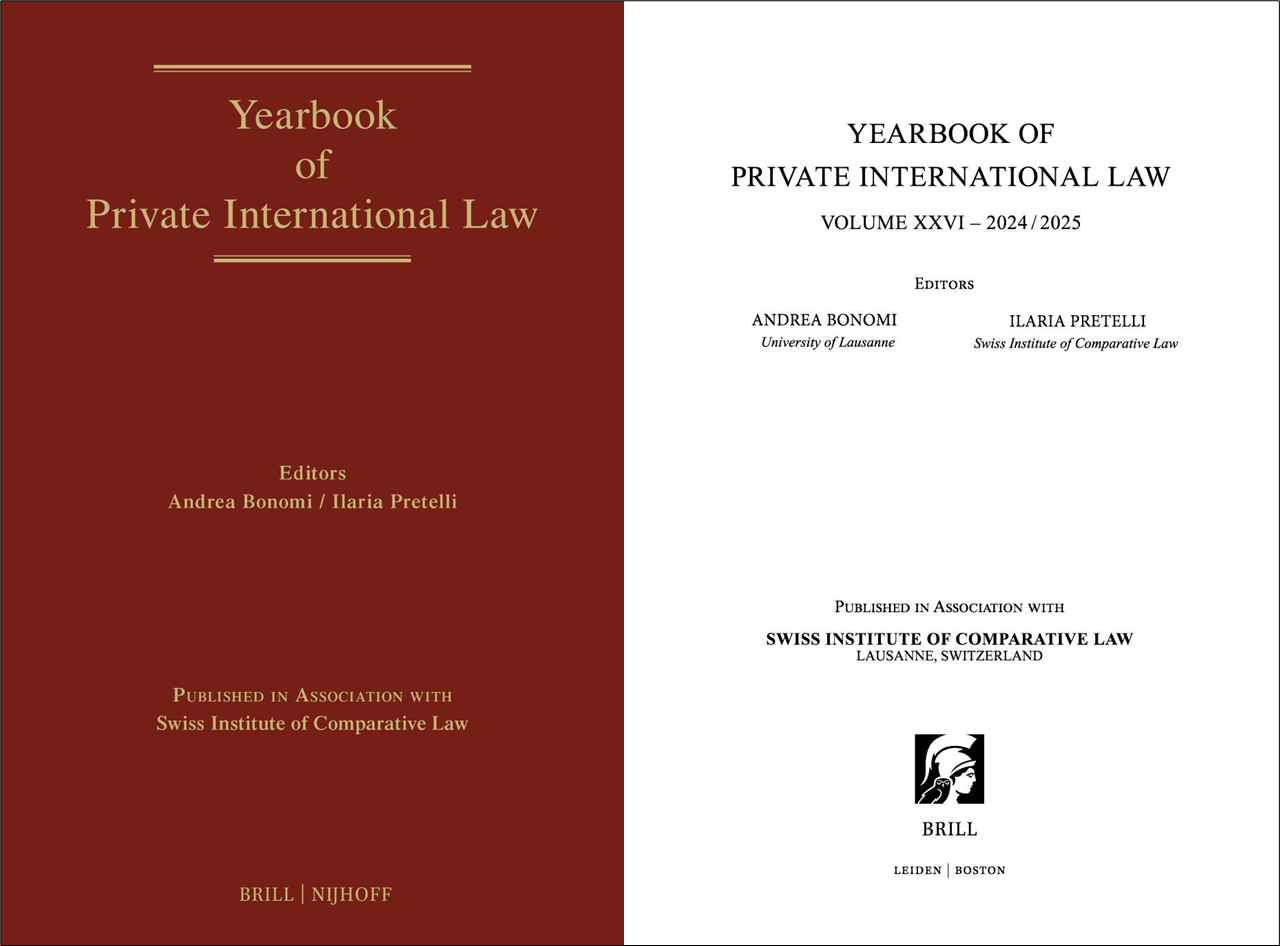
Recenty, the 26th volume of the Yearbook of Private International Law has been published (available here). This year’s edition puts a particular emphasis on Choice of Court Agreements, the EU Succession Regulation as well as the impact of the Covid-19 Pandemic on International Family Law:
TABLE OF CONTENTS
Part I: Doctrine
Pascal DE VAREILLES SOMMIERES
Paving the Way for an Internationalist Representation of Private International Law Today
Francesca C. VILLATA
The Law Applicable to Third-Party Effects of the Assignment of Claims – The travaux préparatoires for an EU Regulation
Christiane VON BARY
New Private International Law Rules in the Law of Persons in Germany – Gender and Names
Stefano DOMINELLI
Cross-border Service of Documents via Social Media “Notifications” in
Global and EU Private International Law
Part II: Choice of Court Agreements – Old Issues and Recent Developments
Matthias WELLER
Delineating EU Law from Member State Law – The Latest from the CJEU on Choice of Court Agreements (Inkreal, Lastre, Maersk)
Tania DOMEJ
A Swiss Federal Court Decision on Jurisdiction Clauses and Multiple Defendants
Lyssa Maria BRITO
The Law Governing Forum-Selection Clauses in International Commercial Contracts – Interpretation and Enforcement in Light of Choice-of-Law Provisions
Part III: Court Decisions
Johan MEEUSEN
The Interaction between Freedom of Establishment and Corporate Conflict of Laws in the European Union – The CJEU’s Edil Work 2 Judgment
Etienne PATAUT
Selling Citizenship – A Challenge for Europe – A Commentary on the
CJEU’s Decision in Commission v Malta
Part IV: Decisions on the European Succession Regulation in Comparative Perspective
Patrick WAUTELET
Decisions on the European Succession Regulation in Belgium
Iina TORNBERG / Katja KARJALAINEN
Decisions on the European Succession Regulation in Finland
Patrick WAUTELET
Decisions on the European Succession Regulation in France
Inga KACEVSKA
Decisions on the European Succession Regulation in Latvia
Egle CAPLINSKIENE
Decisions on the European Succession Regulation in Lithuania
Paul CACHIA
Decisions on the European Succession Regulation in Malta
Patrick WAUTELET
Decisions on the European Succession Regulation in the Netherlands
Ioana OLARU
Decisions on the European Succession Regulation in Romania
Part V: COVID-19 Impact on International Family Law
Bogdana OSTROVSKA
International Issues of Surrogacy during the Pandemic and the War in Ukraine
Regiane PEREIRA
The Effects of the Pandemic on Cross-border Parental Relations and in Child Return Proceedings
Tiago Lindolpho CHAVES
The Impact of the Covid-19 Pandemic on International Child Abduction – An Analysis of the Grave Risk Exception and the Prompt Enforcement of the Return Order
Part VI: National Reports
Tamir BOLDBAATAR / Batzorig ENKHBOLD
Child Protection in Mongolia in the Context of the HCCH 1993 Adoption Convention
Mohammed RAKIB-UL-HASSAN
Beyond Judicial Patchwork – The Urgency of a Comprehensive Statute for Private International Law in Bangladesh
Part VII: Forum
N. Kansu OKYAY
Hybrid Dispute Resolution Clauses in International Law
Manuel José SEGOVIA GONZÁLEZ
Cross-border Insolvency Cooperation Agreements – Elements for a Contract Theory of Joint Jurisdiction
Catégories: Droit international général, Flux des sites DIP
The Role of Precedents in Final Appeal Proceedings: Germany, Israel, USA — Panel Discussion (On-Site/Remote), Bonn, 20 January 2026, 6 p.m. German time
The Regional Hubs Bonn, Cologne and Düsseldorf of the German-American Lawyers’ Association (DAJV), together with the German-Israeli Lawyers’ Association (DIJV), the leading law firm Redeker Sellner Dahs and the University of Bonn, invite to a panel discussion at the Bonn offices of Redeker Sellner Dahs.
Germany has recently introduced a “precedent procedure” (“Leitentscheidungsverfahren”) in the German Code of Civil Procedure (“Zivilprozessordnung”, ZPO). The new legislation, only applicable if the outcome is relevant to a “multitude” (“Vielzahl”) of other proceedings, entered into force on 31 October 2024. On that very day, the German Federal Court of Justice (Bundesgerichtshof) immediately made use of this new tool and elevated to a “precedent procedure” a pending litigation against Facebook on damages for immaterial harm from “scraping” according to Article 82 European General Data Protection Regulation (“Scraping Complex”). This was to ensure that the Court be able to deliver an opinion on the relevant question of law even if the parties were to settle the case meanwhile. In the following, the parties did not settle, and the Court delivered its regular judgment soon afterwards, on 18 November 2024. Since then, the Court has not yet used this tool again, as it seems.
Germany is a civil law jurisdiction where, formally speaking (and leaving some exceptions aside), there are no binding precedents. Yet, there has been a long debate on “persuasive precedents”, i.e. the expectation and practice that lower courts follow the judgments of the Federal Court of Justice (and other highest courts), unless they put forward thorough legal reasoning for departing. A plethora of fundamental and practically relevant questions arises in this context: Do judgments of the courts create “law” or do they merely tell us what the law says that the legislator enacted? What, if any, are the constitutional constraints on judicial development of the law? Is the concept of “persuasive precedents” a satisfactory calibration between rendering justice in the individual case and stability of the legal system? What is the status of an opinion of the German Federal Court of Justice in the new precedent procedure in this context? Why does it only cover cases with relevance to a multitude of other proceedings? Is this “multitude” the same as the relevance of the point in law for a “multitude” of cases to grant access to first and final appeal (“fundamental relevance” [“grundsätzliche Bedeutung”])? What is the role of the three layer appeal system in its entirety in this regard? How does the independence of the judiciary come into play and how does this institutional guarantee relate to available disciplinary measures against “slow” and “ineffective” judges? To what extent do judges tend to discipline themselves by following precedents to promote themselves for higher-ranking posts?
All of these questions are highly relevant in other jurisdictions as well, but they are placed in fundamentally different contexts. Israel is a mixed jurisdiction with elements from common law and civil law. How do the Israeli Supreme Court and the lower courts deal with these issues? What is the law-making role of the Supreme Court in the context of constitutional tradition and practice? Is it advisable to combine the function of final appeal with judicial review of the executive and legislative branches of the state? Is there a particular politicization of final appeal proceedings as well, next to this trend in regard to judicial review proceedings? What effect should the role of precedents have on the procedure of appointing judges to the Supreme Court? Similar questions appear with a view to the United States, but there these questions are placed within a common law context. Having regard to recent decisions of the Supreme Court, how binding is precedent, and when can it be overturned? Also, what is the purpose of the “shadow docket”, and what does its apparently increased use signify in current Supreme Court practice? How important is precedent for the rule of law?
These and other questions will be addressed by a distinguished panel that represents the three jurisdictions and diverse perspectives:
Panelists:
Dr Thomas von Plehwe, Attorney admitted to the Bar of the German Federal Court of Justice (“Rechtsanwalt beim Bundesgerichtshof”), Karlsruhe, Germany.
Professor Barak Medina, The Landecker-Ferencz chair in the study of Protection of Minorities and Vulnerable Groups, Hebrew University Jerusalem, Israel.
Professor Russell A. Miller, J.B. Stombock Professor of Law, Washington & Lee School of Law, Lexington, USA.
Moderators:
RA Professor Dr Peter Andreas Brand, Redeker Sellner Dahs Rechtsanwälte, Berlin Offices.
Professor Dr Matthias Weller, Mag.rer.publ., MAE, Director of the Institute for German and International Civil Procedural Law, Regional Board Member for Bonn of the DAJV.
The venue is Willy-Brandt-Allee 11, 53113 Bonn. Participation is possible on site or via video conference.
We are looking forward to seeing you there!
Registration at sekretariat.weller@jura.uni-bonn.de
Catégories: Droit international général, Flux des sites DIP
Report on the 4th Asian Private International Law Academy (APILA) Conference
The 4th Asian Private International Law Academy (APILA) Conference was held on 13–14 December 2025 in Doshisha University (Kyoto, Japan). The two-day Conference explored a wide variety of questions and issues on private international law in Asia. It featured 21 papers delivered by leading and emerging scholars. Each paper was followed by a Q&A and discussion session among over 40 attendees. Attendees thoroughly enjoyed the rich intellectual exchanges within the close-knit (and expanding) community of APILA, and also the reception (with an impressive selection of food and drinks) on the first night of the Conference.
The keynote address this year was delivered by Dr Chukwuma Okoli, Assistant Professor in Commercial Conflict of Laws at the University of Birmingham. Dr Okoli spoke about his ongoing project, ‘Choice of Law for Employment Contracts in Africa: Imitation, Evolution and Revolution’. He argued that Africa plays an important role in shaping cross-border issues of employment contracts, and African perspectives should be considered in future harmonisation efforts on the topic. He also reflected critically on the development of African private international law, and the lessons from and for Asian private international law.
The 20 papers focused on a vast array of topics, encompassing theoretical and practical aspects of private international law in a wide range of Asian jurisdictions. A list of papers presented at the Conference (in alphabetical order of their titles) is as follows:
- Bankruptcy and Foreign Immovable Property: The Way Forward from Kireeva
- Beyond Performance Metrics: Explaining the Slow Growth of International Commercial Courts Compared to Arbitration
- Can Genuine Harmonisation in International Commercial Arbitration be Achieved without Islamic Law: Reconsidering Islamic Law’s Alleged Incommensurability with Civil and Common Law
- Cross-Border Insolvency and International Arbitration Agreements at Common Law
- Do Directors Owe a Duty to Ensure Corporate Compliance with (Foreign) Law?
- Global Standard Setting for the North? Rethinking the Regulatory Transformation of Private International Law from a Global South Perspective
- How to Unintentionally Win Two Japanese Moots: AI Tools and Multilingual Advocacy
- International Family Law: Quo Vadis?
- Islamic Law and Private International Law in Non-Muslim Majority Jurisdictions: Rethinking Private International Law through the Philippine and Australian Experience
- Islamic Law before Japanese Courts: Special Focus on Dissolution of Marriage
- Law Applicable to Tokenisation: Medium-Centred vs Right-Centred Approaches
- LGBTQ and Private International Law: Recognition of Same-Sex Marriage and its Effects in Japan
- Overstepping TRIPS
- Private International Law in Transnational Personal Data Litigation: Chinese Perspective
- Reassessing the Mode of Proof of Foreign Law
- Recognising Foreign Gender Identity in Hong Kong through Private International Law
- Rethinking Jurisdiction in the Era of Generative AI
- Standing and Characterisation in Corporate Social Responsibility (CSR) Disputes in Private International Law: Türkiye’s Position as a Bridge between Asia and Europe
- The Establishment of the Competence-Competence Principle in the Chinese Arbitration Act 2026
- The Law Applicable to Crypto Assets in Japanese Courts: Comparative and Methodological Considerations
The 5th APILA Conference will be held on 12–13 December 2026 in Seoul, South Korea. Interested speakers and attendees may wish to mark their diaries now. A call for papers will be circulated in due course.
Catégories: Droit international général, Flux des sites DIP
Succession Regulation and Third State Nationals: the OP Case Back in Domestic Courts
This post was prepared together with Aleksandra Karlińska (student researcher in EUSuccess Project at Jagiellonian University). This post describes the outcome of the OP case, after the ruling given by the Court of Justice of the European Union (C-21/22), back in front of the referring court, as in 2025 the Regional Court in Opole (II […]
Catégories: Droit international général, Flux des sites DIP
Conflict of laws in the South African courts: a recent missed opportunity
Posted on behalf of Jason Mitchell, barrister at Maitland Chambers in London and at Group 621 in Johannesburg.
It’s rare for conflict of laws to come up in South African courts (with the notable exception of the Turkcell litigation from earlier this year; see the summary on this site at https://conflictoflaws.net/2025/south-africa-grapples-with-the-act-of-state-doctrine-and-choice-of-law-in-delict/).
A recent High Court judgement, Placement International Group Limited v Pretorius, is an opportunity missed. A Hong Kong company is in the business of recruiting South Africans and placing them with international companies. It employed two South Africans to do the recruitment. They worked for the company for several years and, so the company alleged, acquired confidential information about the company’s customers, methods, and the rest. The two employees resigned and started their own competing company. The employment contracts were governed by Hong Kong and had restraints of trade (the judgement does not say if there were dispute resolution/jurisdiction clauses). The company applied for an interdict against the two employees and the competing company in South Africa.
The company chose not to sue on the restraints of trade in the employment contracts (or on any contractual rights to confidentiality that are usually included in restraints). Instead, the company based its cause of action on delict (in general, the use of trade secrets and confidential information is a species of unlawful competition under South African law). The company seems to have made that choice because, so it thought, it had no cause of action under Hong Kong law.
The court dismissed the application, but its reasons are unclear. According to one interpretation of the judgement, the primary reason for dismissing the application was that the main harm, a specific job fair where the company conducts most of its recruitment, had already occurred, making an interdict no longer necessary. On another reading, the court seems to doubt that the company even made out the necessary prima facie right, partly because there was nothing confidential to protect but also, importantly, because of the effect of Hong Kong law governing the contracts.
Throughout the judgement, there is an unexpressed concern regarding forum shopping. The premise of this concern is that, at least according to the judgement, the restraints of trade are void under Hong Kong law (and that, presumably, there is no equivalent protection for confidential information under Hong Kong law). The parties did not present any evidence regarding Hong Kong law on this issue.
From that premise, the judge concluded that the company jettisoned a doomed (Hong Kong-governed) contractual claim for a viable (South African-governed) delictual claim.
It is regrettable that there was no engagement with characterisation and choice of law. The judge is alive (and concerned about) the link between the employment relationship and confidentiality duties. Under South African choice of law rules, the choice of law rule for delict is the lex loci delicti, but it may be displaced by the law of the country with a manifestly closer, significant relationship to the occurrence and the parties. The court should have at least gone through the conflicts process to determine whether Hong Kong law had a manifestly closer relationship, considering that it governed the employment relationship.
The judgment is available here: https://www.saflii.org/za/cases/ZAGPPHC/2025/1252.html
Catégories: Droit international général, Flux des sites DIP
Symeonides on Private International Law Bibliography 2025: U.S. and Foreign Sources in English
There is no better Christmas present than a comprehensive and up-to-date compilation of the previous year’s scholarship in private international law, and when that bibliography is prepared by Professor Symeon C. Symeonides (Alex L. Parks Distinguished Professor of Law, Dean Emeritus), it is truly something special.
As usual, and without fail for the past twenty years, Professor Symeonides has produced an exceptionally thorough and reliable survey of the field.
The 2025 compilation (Private International Law Bibliography 2025: U.S. and Foreign Sources in English) lists no fewer than 115 books and 397 journal articles devoted to private international law (or conflict of laws) and related areas.
The Absract reads as follows:
“This is the twentieth annual bibliography of private international law compiled by the undersigned as a service to fellow teachers and students of this subject. It includes 115 books and 397 journal articles that appeared in print in 2025.
The term “private international law” is used here in the broadest and arguably expanded sense. It encompasses not only the three divisions of the law of conflict of laws (adjudicatory jurisdiction, choice of law, and recognition of sister-state and foreign judgments), but also prescriptive jurisdiction, extraterritoriality, federal-state conflicts, as well as certain aspects of arbitration, the law of foreign relations, and international human rights.
AI Note: This compilation is the product of human labor-mine. I have visually verified all entries, although I have used electronic search engines to locate them. I have not used generative artificial intelligence (AI).
Access to the bibliography is available on Prof. Symeonides’ SSRN page here.
Readers may also wish to consult his insightful essay, Reflections from Fifty Years in the Conflicts Vineyard, in which he offers a concise yet profound and wide-ranging reflection on half a century of scholarship in the field, available here
Many thanks to Professor Symeonides for this invaluable contribution, which continues to be an essential resource for scholars and practitioners alike.
Catégories: Droit international général, Flux des sites DIP
My keynote at BIICL 15 December 2025.
I had promised participants of the BIICL Business and Human Rights Annual Forum Annual Conference that I would be putting up my handwritten notes for my keynote, in electronic format. Here they are. It was a great forum.
Geert.
Third Issue of the Journal of Private International Law for 2025
The third issue of the Journal of Private International Law for 2025 was just published. It contains the following articles:
Elena Rodríguez-Pineau, “Cross-border insolvency avoidance actions in the EU: a necessary reflection”
After 25 years, the European Union can boast of having harmonised EU cross-border insolvencies in a Regulation (recasted once). The EU is presently addressing substantive harmonisation of insolvency law (via Directives) within the Union with a focus on restructuring and stakeholders’ interests. Although such legislation should apply without prejudice to the EU Insolvency Regulation, this approach is somewhat difficult to articulate since that Regulation was drafted with a focus on liquidation and maximising creditors’ protection. This tension is particularly acute in relation to transaction avoidance actions as the Regulation sets a double avoidance requirement while the proposed Directive fosters a more pro-avoidance position. This paper suggests several options that the EU legislature may follow to revise the Regulation’s transaction avoidance rule. It is contended that such revision needs to bear in mind how the issue is being addressed outside the EU in order to consider the ad extra regulation of said actions.
Benjamin Hayward, “So many thoughts about Tesseract: a private international law perspective”
On 7 August 2024, the High Court of Australia handed down its decision in Tesseract International Pty Ltd v Pascale Construction Pty Ltd. In doing so, it held (contrary to existing practitioner consensus) that certain Australian proportionate liability laws apply in Australian domestic commercial arbitration. Existing analyses assess this case from an arbitration perspective. As this article shows, however, the case is really about private international law. This being so, this article critiques the High Court’s reasoning and also Tesseract’s existing commentaries from a private international law perspective. As arbitration is a dispute resolution process grounded in law, these critiques are offered in the service of helping Australian arbitration better secure its trade facilitation purposes.
Stefano Dominelli, “Torts in outer space: conflict of laws perspectives”
Human activities in outer space impose a reflection on the structural inadequacy of current connecting factors, such as the lex loci damni, which may not properly operate when all events are localised in areas (rather than a territory) not subject to the sovereignty of a State. By integrating space law principles and interests in conflict of law approaches, the aim of this work is to propose connecting factors which may apply in cases of satellite collisions or for torts in sub-orbital flights. Different constellations are created, each of which requires a specific assessment of the relevant interest which should mould specific solutions.
Thu Thuy Nguyen, “Governance of low-skilled labour migration: rethinking the potential of private international law for the promotion of decent work for migrant workers”
The proliferation of temporary labour migration programmes has enabled low-skilled workers from developing countries to seek employment in industrialised countries. However, due to inadequate regulatory frameworks at the national and international levels, these programmes fail to ensure decent work for the low-skilled migrant workers. By utilising the low-skilled labour migration between Vietnam and Japan as a case study, this article highlights the failure of the current regulatory framework in adequately governing the intermediaries and employers throughout the migration process. This article also presents the private international law challenges faced by migrant workers when initiating transnational civil litigation against abusive intermediaries and employers before Vietnamese or Japanese courts. To combat the exploitative practices of the migration industry and promote decent work, besides reforming ex-ante regulations, this article argues that the international community should reconsider the potential of private international law. This paper advocates that private international law could be better crafted to enable different stakeholders to engage in social dialogue about, and to seek the realisation of, the value of decent work. Based on this argument, this paper proposes solutions to remedy Vietnamese and Japanese private international law rules to facilitate the realisation of the value of decent work for low-skilled migrant workers under temporary migration programmes.
Aygun Mammadzada, “Beyond the model law: the case for a Commonwealth-wide adoption of the Hague Judgments Convention”
The 2019 Hague Judgments Convention (Judgments Convention) marks a pivotal development in private international law, offering a uniform framework for cross-border enforcement that enhances predictability and reduces legal fragmentation. By promoting legal certainty, it supports international trade and commercial relations and aligns with the broader push for greater judicial cooperation in the interconnected world. This article argues that it is in the clear interests of Commonwealth states to ratify the Convention. The Convention offers an avenue to strengthen the “Commonwealth advantage” by leveraging shared legal traditions and institutional ties to facilitate cooperation which the Commonwealth Model Law is unlikely to do on its own. Set against the backdrop of Brexit and the UK’s search for new legal alignments, the article further proposes that the UK’s ratification of the Convention can serve as a source of proactive inspiration for other Commonwealth states. As the key influencer and first Commonwealth state to ratify the Convention (apart from Malta and Cyprus, which acceded through their EU membership), the UK is uniquely positioned to promote wider adoption and reinforce both legal integration and commercial certainty. Such cooperative efforts can further consolidate the Commonwealth’s role in shaping the evolution of global private international law.
Bianca Scraback, “The international element requirement for consumer contract jurisdiction in the Brussels Ia Regulation”
Whether or not local jurisdiction in consumer contract cases is regulated in the EU by the Brussels Ia Regulation or domestic rules on jurisdiction hinges on the existence of a relevant international element. Even determining the relevance of international elements using a rules-based approach and despite two decisions of the CJEU, the paper argues that the requirement leads to unpredictability that is not warranted in light of the interests involved. It therefore proposes a legislative change limiting the determination of local jurisdiction to consumer contract cases where the parties are not both domiciled in the same Member State. If there are more than two parties involved, the paper proposes to include a rule modelled after Article 8(1) of the Brussels Ia Regulation.
Bálint Kovács, “Europeanisation of private international law: Balancing national traditions and EU rules”
The reviewed monograph provides a thorough examination of Hungarian private international law, set against the backdrop of EU private international law developments, and their application by the Hungarian judiciary. The book begins with a historical overview of Hungarian private international law, culminating in the 2017 recodification under the Act on Private International Law (APIL). It systematically explores sources of private international law, including national legislation, EU regulations, and international treaties. Key issues such as choice-of-law principles, jurisdiction, recognition and enforcement of judgments, and international civil procedure are dissected with comprehensive reference to Hungarian jurisprudence. The book also contains the English translation of the Hungarian APIL, as well as a complete list of bilateral and multilateral international agreements that include private international law provisions to which Hungary is a party. Its clarity, analytical depth, and practical insights make it a significant contribution, and an invaluable resource for both scholars and practitioners.
Catégories: Droit international général, Flux des sites DIP
EP’s First Reading on the Proposal to Amend the Corporate Sustainability Due Diligence Directive
On 16 December 2025, the European Parliament approved at first reading the proposal for a directive amending, among other legislative measures, Directive (EU) 2024/1760 on corporate sustainability due diligence (CSDDD). The proposal now awaits approval by the Council of the European Union. As reported on this blog, the amending directive, part of the Omnibus Simplification […]
Catégories: Droit international général, Flux des sites DIP
Pages
Sites de l’Union Européenne
- Europa, portail de l'UE
- Eur-Lex, moteur de recherche du droit de l'UE
- Répertoire de la législation de l'UE en vigueur
- Cour de justice de l'UE
- Direction Justice de la Commission
- Observatoire législatif du Parlement
- Suivi des procédures interinstitutionnelles
- Synthèses de la législation de l’UE
- Portail e-Justice
- JURE, décisions nationales (Bruxelles I et II bis)
- Atlas judiciaire européen en matière civile
- Réseau judiciaire européen
- EuroVoc, thesaurus multilingue de l'UE
- IATE, base terminologique de l'UE
Theme by Danetsoft and Danang Probo Sayekti inspired by Maksimer